
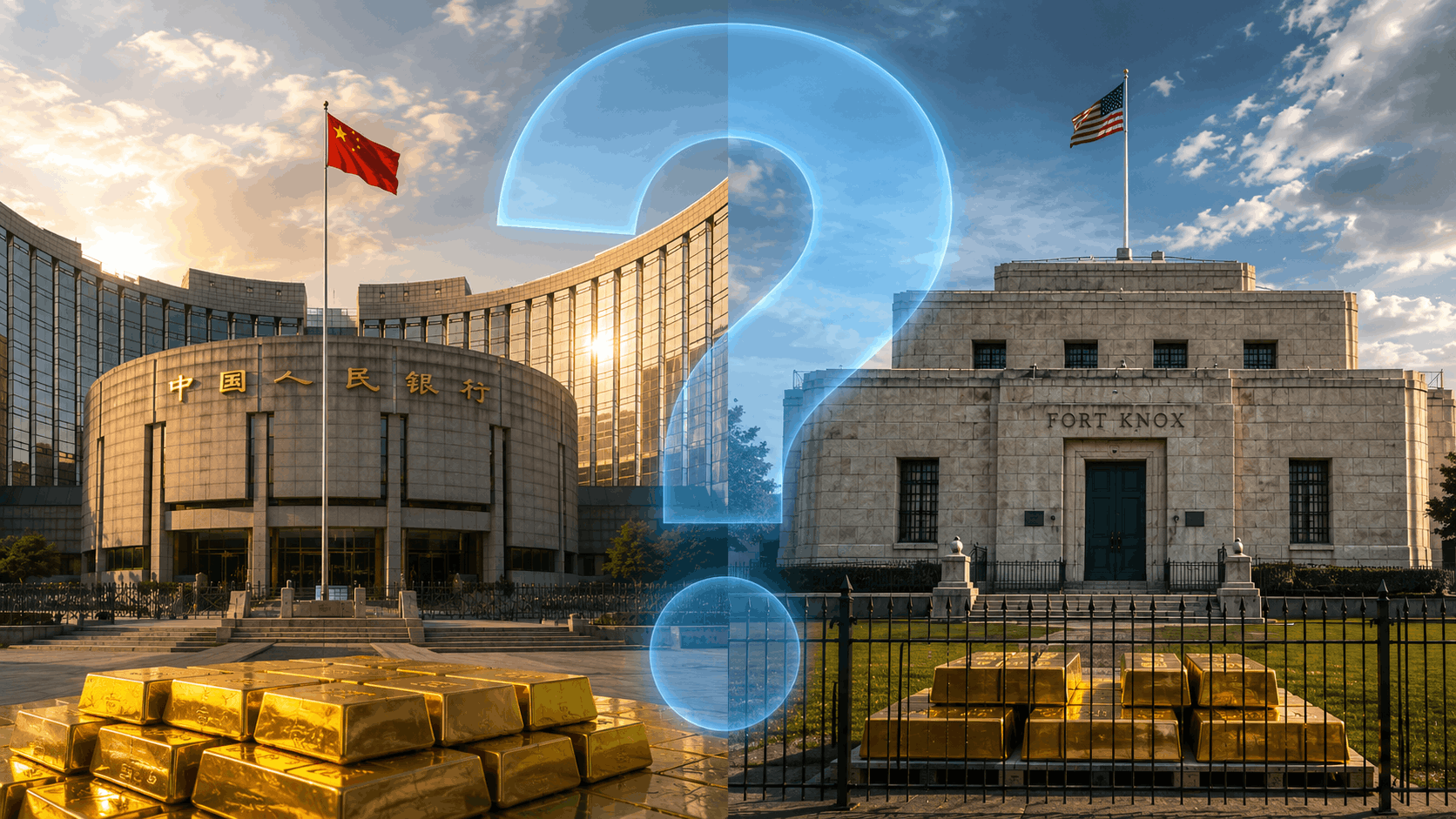
Officially, the U.S. has far more gold than China.
But does it really?
In this week’s Midweek Memo podcast, Mike Maharrey explains why there is reason to doubt this claim. In fact, we don’t really know how much gold the U.S. or China holds. We have official claims, but the U.S. refuses to audit its reserves, so there could be far less than advertised. And it’s evident China is accumulating gold faster than it claims.
Why this dichotomy? And what are the ramifications?
“Simple question, right? We can just look it up.
“So, the US has 8,133.5 metric tons of gold. That’s roughly 261.5 million troy ounces. About half of that (147.3 million ounces according to the U.S. Mint) is stored at Fort Knox. The rest is spread out between the Denver Mint, the West Point Bullion Depository, and the Federal Reserve vault in New York.
“So, there ya go. Case closed. End of podcast. Or is it? I mean, that’s how much gold the government says it has. But we don’t really know, do we? Because for some reason, they absolutely do not want to do a proper audit.
“OK, so now, let’s do China. How much gold does China have? That should be pretty easy too.
“I looked it up. 2,346 tonnes.
“But can we trust the Chinese gold accounting any better than America’s?
“Yeah. No. It’s not so much that the Chinese haven’t done an official audit. I have no idea what their audit situation is. But I do know that it’s almost certain the Chinese have a lot more gold than they claim.
“So, to sum it up, the US may well have less gold than advertised, and China may have a lot more.
“I want to dig into this a little more deeply today.”
Starting with U.S. gold reserves, I have some good news.
“We don’t need to worry about that Fort Knox gold audit anymore. Treasury Secretary Scott Bessent assured us all the gold is there.
“There you have it. The fox guarding the henhouse says the hens are all accounted for.
“Case closed!
“Or maybe not.”
I point out that despite Bessent’s assurances, we don’t really know because the government refuses to audit its gold reserves.
“Consider this: would you trust a bank that never conducted an external audit?”
You shouldn’t.
I note that audits serve several functions. They catch honest mistakes, and they hold those in control of an organization’s financial dealings accountable and ensure they are operating above-board.
Despite the lack of a formal audit, the U.S. government insists the gold is all there and accounted for, and they claim they’ve audited it.
They have not.
However, in the 1970s, the government put on a made-for-TV spectacle in the name of an audit. They invited reporters and politicians to look inside Fort Knox and hold gold bars.
“So, yeah. That’s not an audit. It’s political propaganda. In a proper audit, every bar would be counted and inspected. Serial numbers would be matched to records. The gold would be assayed to verify its weight and purity. And the details of the audit would be published and available for public inspection. None of that has happened.”
Since then, the government claims it conducted a multi-year process of opening and inventorying vault compartments and affixing new tamper-evident seals to the doors of each compartment upon completion. They call these audits. They are not.
Some reports have since gone missing, and there is no record of comprehensive assaying, weighing, or transactional history available to the public.
“Furthermore, there is evidence that seals on vault compartments have been broken over the years, bars have been moved for unknown reasons, and seals have been re-affixed without fresh auditing. Subsequent annual reviews of the schedules of compartment seals simply whitewash prior discrepancies. In sum, the U.S. Treasury’s management of U.S. gold reserves is replete with audit “no-nos” that would never pass muster at a responsibly run private depository.”
I raise a question. If the government doesn’t have anything to hide, why are people so resistant to an audit?
“Maybe it’s just me, but when somebody gets all upset when I suggest checking their work, I suspect their work might not be up to par.”
I turn to the Chinese, noting that it has increased its official gold reserves for 21 straight months. But it appears they have accumulated far more gold than reported.
“Here’s the rub. While there is reason to believe the US might not have as much gold as it claims, the Chinese almost certainly have far more.”
Some analysts have speculated that the Chinese are accumulating gold much faster than they claim for years. However, the mainstream has shown little interest in the story. Last year, Money Metals analyst Jan Nieuwenhuijs parsed the data and determined that the Chinese central bank covertly bought 570 tonnes of gold in 2024. The People’s Bank of China only reported a 41-tonne increase in its gold reserves that year.
Since then, a few mainstream players have taken notice. Last fall, the Financial Times reported on Chinese gold accumulation, and more recently, Goldman Sachs noted that China bought nearly five times more gold in May than it reported.
Mike notes that Goldman analysts said they expect central bank gold accumulation to provide a price floor for the yellow metal, even as gold continues to face downward price pressure due to a hawkish Federal Reserve.
Speaking of the Fed, I point out the July meeting was ongoing as he recorded the show. Most people expect the Fed to stand pat on interest rates, but a few analysts forecasted a rate hike.
“I’ll say this. If they do hike, I think it will hasten the debt crisis and an economic collapse. A global economy dominated by a debt black hole can’t operate in a higher interest rate environment. Anyway, that’s a topic for next week. In the meantime, I’m still near-term bearish. I think the gold and silver prices will continue to languish until the markets figure out that Warsh’s inflation war is more propaganda than actual war.”
I wrap up the show noting that Chinese investors are also buying gold, with imports into China hitting a 2-year high last month. Jinrui Futures Company analyst Zijie Wu told Bloomberg investors buying the price dip were “an important driver of recent demand.”
“Might not be bad advice for American investors. Because remember, no matter how many hawkish words that pour out of Warsh’s mouth today, no matter what the Fed does in terms of monetary policy, we know one thing for certain. The dollar will be worth less a year from now than it is today. That’s by design. Stealing 2 percent of your purchasing power every year is the plan. That means you need to plan accordingly.”
